Cohere vs Mistral vs Writer vs Aleph Alpha: The Enterprise Buyer's Guide to On-Prem LLMs
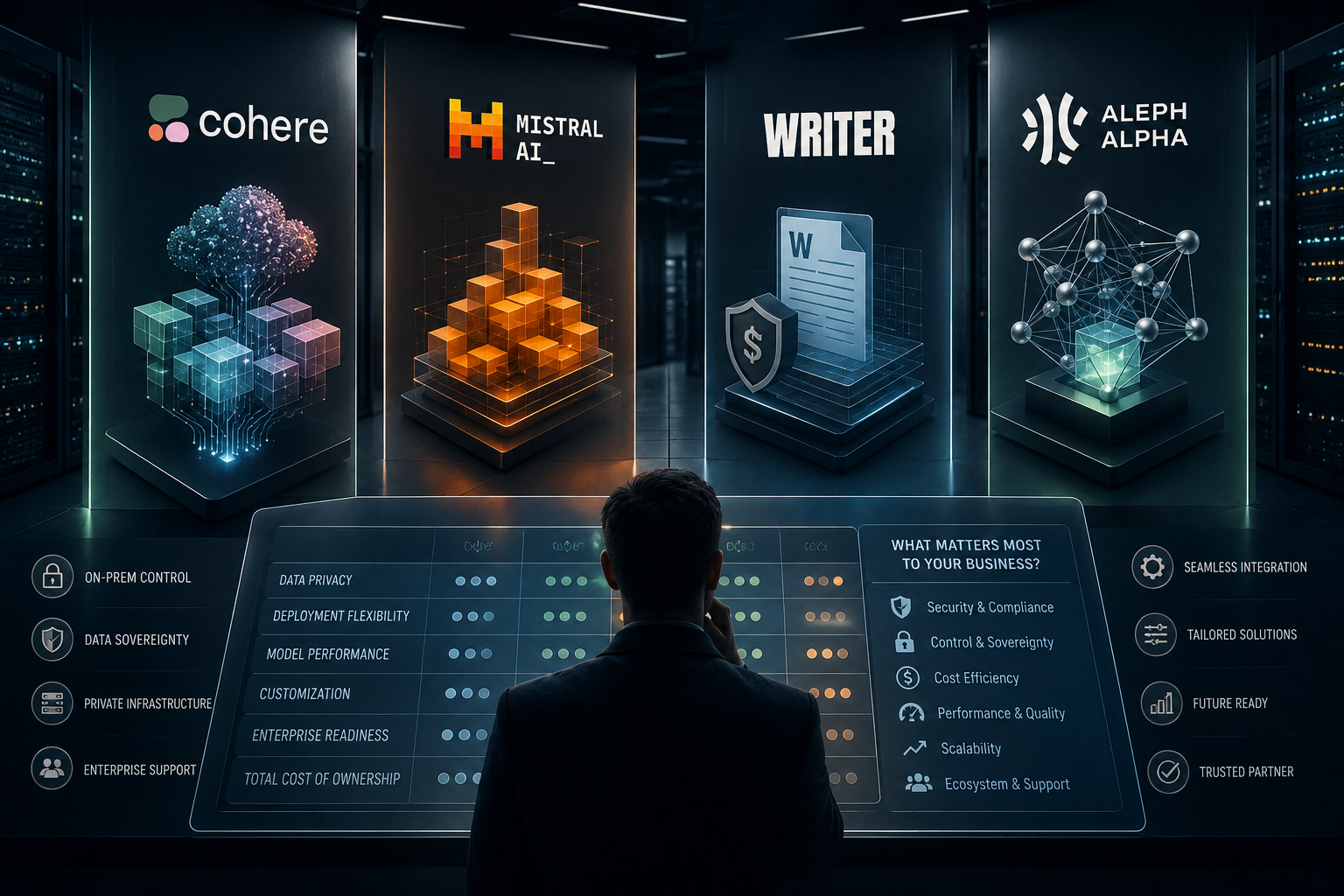
Not every enterprise can send data to OpenAI or Google. For organizations that need weights on their own infrastructure — with a vendor of record, IP indemnity, and a no-train guarantee — four vendors define the commercially-licensed LLM market. Here is how they compare and which one fits your use case.
Why Open-Source LLMs Are a Security Problem Enterprises Cannot Ignore
In December 2025, three zero-day vulnerabilities were discovered in PickleScan — the primary tool Hugging Face uses to scan uploaded models for malicious payloads. Each scored CVSS 9.3. While PickleScan was supposed to be the safety net, attackers could bypass it entirely and distribute weaponized model files that execute arbitrary code the moment you load them.
That was not an isolated incident. PyTorch's torch.load() — the function used to load the vast majority of open-source models — was found vulnerable to arbitrary code execution even with the weights_only=True safeguard enabled (CVE-2025-32434). JFrog detected a 6.5x increase in malicious models on Hugging Face in 2024, with 95% using pickle-based exploits. A malicious model masquerading as an OpenAI release accumulated 244,000 downloads before anyone noticed. Ollama has racked up six critical CVEs in two years, including remote code execution and memory leaks that expose user prompts. And EDR solutions? They are essentially blind to model-layer threats — backdoored weights, trigger-based behavior, and steganographic payloads are invisible to every commercial endpoint security tool on the market.
For a comprehensive technical analysis of these risks — including model file format vulnerabilities, inference engine CVEs, supply-chain attack vectors, and EDR detection gaps — see our full research report: The Hidden Risks of Downloading and Running Open-Source LLMs Locally.
This is the reality driving a fundamental shift in enterprise AI procurement. Organizations that need AI on their own infrastructure are increasingly looking beyond the "download from Hugging Face and hope for the best" approach — toward vendors who provide model weights under commercial license, with a vendor of record, IP indemnity, security guarantees, and professional support.
Four vendors define this commercially-licensed LLM market. Understanding who they are, how they differ, and which one fits your use case is the focus of this guide.
The Real Fork: Model Vendor vs Platform Vendor
Before comparing individual products, recognize that these four vendors split into two fundamentally different sub-patterns:
Model vendors (Cohere, Mistral) hand you weights and a runtime under license. You run inference on your own GPUs. You need ML-ops capability in-house — vLLM, GPU orchestration, fine-tuning pipelines. The lock-in is at the model level, which means switching costs are lower.
Platform vendors (Writer, Aleph Alpha) deliver a wrapped stack — model plus RAG plus guardrails plus governance — often co-built for your use case. They operate more of the stack. The lock-in is at the ecosystem level, which means switching costs are higher but time-to-value is faster.
This distinction matters more than any benchmark score. If your organization already runs GPU infrastructure and has ML-ops depth, the model-vendor route gives you maximum control. If you need a turnkey solution and lack the engineering to operate raw model weights, the platform route gets you to production faster.
Consolidation Alert: The Field Is Shrinking
Before diving into the four profiles, one critical development: Cohere is acquiring Aleph Alpha. The deal was announced in April 2026, with an estimated combined valuation of approximately $20 billion and a $600 million anchor investment from the Schwarz Group. Closing is expected in the second half of 2026, pending regulatory clearance from Germany, the European Commission, and Canada.
A unified Command-Pharia model is planned for Q4 2026. The combined entity will be majority non-Canadian-controlled, which raises questions about the EU sovereignty clauses that made Aleph Alpha attractive to German government contracts in the first place.
This means the field is effectively 3.5 vendors today, and the most sovereignty-pure option is the one whose independence is dissolving. Factor this into any long-term commitment.
Cohere: The Deployment-Economics Model Vendor
Headquarters: Canada
What they offer: Cohere builds dense and mixture-of-experts (MoE) models optimized for multilingual enterprise workloads. Their flagship Command A (111B dense) runs on just two A100 or H100 GPUs — one of the smallest production footprints in the category. Command A+ (218B sparse MoE, 25B active parameters) consolidates reasoning, vision, translation, and general capabilities into a single weight set, supporting 48 languages and running on two H100s with quantization.
Deployment flexibility: SaaS API, AWS Bedrock, Azure marketplace, your VPC, on-prem, air-gapped, and a dedicated Model Vault option. Setup for self-deployment reportedly takes under a day.
Licensing trend: Cohere is deliberately moving toward open licensing. Command A+ shipped under full Apache 2.0 — no revenue caps, no field-of-use restrictions, legally deployable in air-gapped environments. The moat is shifting from weight secrecy to support, vendor-of-record value, and the Aleph Alpha assets.
Data and indemnity: Contractual no-training-on-customer-data guarantee. Zero vendor access to your infrastructure or data. IP indemnity is offered and negotiable. SOC 2 Type II certified.
Best for: Multilingual deployments, RAG with built-in citations, organizations with modest GPU budgets that need the smallest possible serving footprint, and regulated procurement requiring a Western vendor of record.
Mistral: The EU-Sovereignty Model Vendor
Headquarters: France
What they offer: Mistral has the widest model portfolio of any vendor in this category, spanning from frontier to edge. Their lineup includes Mistral Large (the flagship, up to approximately 675B sparse MoE in the latest generation), Medium and Small tiers, Ministral 3B and 8B for on-device and edge deployment, Codestral and Devstral for code, Pixtral for vision, Voxtral for speech, Magistral for reasoning, and OCR 4 — which ships as a single Docker container for on-prem document extraction.
Deployment flexibility: API via La Plateforme (EU data centers), on-prem, self-hosted, private cloud, Le Chat Enterprise (managed), and Mistral Forge — a program where you train custom frontier models on your own GPU clusters under a software-license fee. Forge optionally includes a "forward-deployed scientist" from Mistral embedded in your team.
Licensing: Explicitly tiered and requires careful attention. Some models are Apache 2.0 (free commercial self-host). Others fall under the Mistral Research License (non-commercial only; production use requires a paid commercial license). Some newer models use a Modified MIT license. Your contract must state which license governs each model you deploy.
Data and indemnity: No Telemetry Mode contractually guarantees prompts are not used for training. IP indemnity is in the Commercial Terms, covering third-party infringement claims with stated exclusions and liability caps.
Jurisdiction advantage: France and EU — the strongest CLOUD Act and sovereignty argument in this group. Jurisdiction follows the company's headquarters, not the server location. Running on an "EU region" of a US hyperscaler does not fully address this; Mistral's structural position does.
Best for: EU data-residency requirements, organizations needing one vendor from cloud to edge (Ministral on-device is a real edge story), and teams wanting custom pre-training on proprietary data via Forge.
Writer (Palmyra): The Turnkey Agentic-Platform Vendor
Headquarters: United States
What they offer: Writer is a platform company, not just a model company. Their Palmyra X5 model supports a one-million-token context window with hybrid attention architecture, ingesting a million tokens in approximately 22 seconds with function calls executing in around 300 milliseconds. Domain-specific models exist for finance (Palmyra Fin), medical (Palmyra Med), and creative work.
The real product is the platform — AI HQ, a system for building, activating, and supervising AI agents, with built-in RAG and guardrails. Writer's models are trained heavily on synthetic data, which creates a cleaner provenance story for IP-sensitive deployments. The models are never post-training quantized or distilled, so validated behavior stays stable across environments.
Deployment flexibility: Writer platform (SaaS), AWS Bedrock, NVIDIA AI Enterprise, and on-prem within customer infrastructure under an enterprise contract.
Data and indemnity: Zero data retention, no training on customer data. IP indemnity in the Platform Services Agreement covers the SaaS platform. However, on-prem indemnity is a separate negotiated agreement — this is a critical procurement detail that must be addressed explicitly for self-hosted deployments.
Best for: Regulated verticals (finance, healthcare) where a finished agentic platform is more valuable than raw weights, and where synthetic-data provenance is a procurement advantage. The caveat: proprietary-ecosystem lock-in is the highest in this group.
Aleph Alpha (PhariaAI): The Sovereign Public-Sector Vendor
Headquarters: Germany
What they offer: Aleph Alpha's product is PhariaAI, a full-stack sovereign AI platform comprising PhariaAssistant, PhariaStudio, PhariaOS, PhariaCatch, and PhariaFiles, plus custom domain models they co-build with the customer. Their T-Free tokenizer-free architecture reduces embedding parameters by approximately 85%.
The standout capability is AtMan explainability — every model output is traceable to its source. This is not a bolted-on feature; it is architecturally native. For organizations subject to the EU AI Act's transparency requirements, this is a differentiator no other vendor in this group matches.
Deployment flexibility: On-prem, STACKIT sovereign cloud (operated by the Schwarz Group — no US hyperscaler at any layer), air-gapped, and hybrid. HPE hardware partnership via GreenLake for full on-prem lifecycle management. Documented classified government deployments exist.
Jurisdiction advantage: Germany and EU, with no CLOUD Act exposure at any layer. Aligned with the Deutschland-Stack initiative. This is as sovereignty-pure as commercially available AI gets — which is precisely why the Cohere merger introduces procurement risk.
Best for: EU public sector, defense, air-gapped mandates, and deployments where output auditability and explainability are contractual requirements. The central caveat: independence is dissolving. Demand contractually binding EU data-residency commitments and monitor regulatory clearance before making any long-term commitment.
Running Commercially-Licensed Models on VCF Private AI Services
Choosing the right model vendor is half the equation. The other half is the infrastructure you run it on. This is where VMware Cloud Foundation Private AI Services comes in — and where the model-vendor route (Cohere, Mistral) becomes particularly compelling.
VCF 9.1 Private AI Services provides a complete on-prem AI platform purpose-built for exactly this use case: running licensed model weights on your own GPU infrastructure with enterprise-grade governance, security, and operations.
DirectPath I/O for bare-metal GPU performance. When Cohere's Command A needs two H100 GPUs or Mistral Large needs four B200s, DirectPath I/O passes the GPU directly to the inference VM — no hypervisor overhead, bare-metal performance with virtualization management. You get the GPU utilization of a bare-metal deployment with the operational benefits of vSphere lifecycle management.
MCP governance for AI tool access. Private AI Services includes Model Context Protocol support, giving you centralized control over which models can access which enterprise tools and data sources. When you are running commercially-licensed models that interact with sensitive internal systems, governance is not optional — it is a procurement requirement.
vDefend IDS/IPS protecting inference traffic. Even with commercially-licensed models that eliminate the pickle/deserialization risks of open-source, your inference endpoints still need network-layer protection. vDefend's virtual patching with IDPS Turbo Mode (9 Gbps per host) inspects all traffic flowing to and from inference workloads, blocking lateral movement and network-layer exploits without adding latency.
AI Metrics Dashboard. Track GPU utilization, inference throughput, and model performance across your entire private AI fleet. When you are operating models from multiple vendors — perhaps Cohere for multilingual RAG and Mistral for code generation — centralized observability matters.
Air-gap support. Both Cohere and Aleph Alpha explicitly support air-gapped deployments. VCF Private AI Services is designed to operate fully disconnected, making it the natural infrastructure for classified or regulated environments where these models need to run without any external connectivity.
For a detailed technical deep-dive into VCF Private AI Services architecture, GPU support (NVIDIA Blackwell RTX PRO 4500, HGX B200, AMD MI350), and CPU-based inferencing via Llama.cpp, see: VCF 9.1 Private AI Services: How to Run Enterprise AI On-Prem.
How They Compare: The Strategic View
The comparison that matters for enterprise buyers is not which model scores highest on a benchmark. It is which vendor aligns with your organizational reality across six dimensions:
Infrastructure readiness. Cohere and Mistral hand you weights — you need GPU ops. Writer and Aleph Alpha hand you a platform — you need less in-house depth. Organizations already running VCF with Private AI Services have the infrastructure muscle for the model-vendor route.
Sovereignty. Mistral (France) and Aleph Alpha (Germany) are EU-headquartered. Cohere is Canadian. Writer is American. For CLOUD Act-sensitive procurement, jurisdiction is a hard constraint, not a preference.
Lock-in. Model vendors (Cohere, Mistral) create model-level dependency — you can swap models. Platform vendors (Writer, Aleph Alpha) create ecosystem dependency — switching means rebuilding workflows.
Edge and on-device. Only Mistral has a real edge story with Ministral 3B/8B. The others are data-center models.
Explainability. Aleph Alpha's AtMan is structurally unique. The others offer citations and guardrails but not per-output source traceability.
Licensing trajectory. The entire tier is drifting toward open licensing. Cohere's flagship went Apache 2.0. Mistral has open tiers. Aleph Alpha open-sourced its base model. The durable competitive moat is shifting from weight secrecy to platform, support, indemnity, and jurisdiction — which is also why the field is consolidating.
The Elephant(s) in the Room: Will Anthropic or OpenAI Enter This Market?
This guide covers the four vendors that define the commercially-licensed on-prem LLM market today. But everyone reading this is thinking the same thing: what about Anthropic and OpenAI?
Both are circling this market from opposite directions. Neither has fully entered it. The signals, however, are getting louder.
OpenAI: The Open-Source Flanking Move
OpenAI has already crossed the air-gap line. In a deployment that reads like a Cold War spy novel, OpenAI engineers physically carried O3 model weights into a U.S. National Laboratory — a facility where phones and electronics are not allowed — and installed the model on the lab's supercomputer. They called it "SneakerNet." It was a custom, one-off deployment for national security, but it proved something important: OpenAI's most advanced reasoning model can run completely disconnected from OpenAI's infrastructure.
Then came GPT-OSS. In 2026, OpenAI released its first fully open-source model family — gpt-oss-20b and gpt-oss-120b — under Apache 2.0. No revenue caps, no field-of-use restrictions, fully self-hostable. The 120B model achieves near-parity with O4-mini on reasoning benchmarks and runs on a single 80 GB GPU. Dell is already packaging it through the Dell AI Factory on Hugging Face. Early enterprise adopters include AI Sweden, Orange, and Snowflake.
GPT-OSS is not GPT-4 or O3. It is a flanking product — good enough for many enterprise use cases, open enough to eliminate licensing friction, and strategically positioned to get OpenAI's weights running inside enterprise infrastructure. The question is whether OpenAI follows this with a commercially-licensed tier of its frontier models. The SneakerNet deployment suggests the technical capability exists. The business model question is whether they will cannibalize their API revenue to capture the on-prem market.
Anthropic: The Self-Hosted Gateway Without the Weights
Anthropic is playing a fundamentally different game. They have never released Claude's model weights — and their Responsible Scaling Policy (RSP) explicitly ties weight release to safety evaluation thresholds that Claude has not cleared. This is a philosophical position, not just a commercial one.
But Anthropic is not ignoring the enterprise demand for control. They shipped a self-hosted Claude Code gateway that lets enterprises run Claude Code inside their own cloud tenancy on AWS Bedrock or Google Vertex AI — with SSO, audit logging, policy enforcement, and spend caps. They introduced self-hosted sandboxes that move tool execution into customer-controlled infrastructure while keeping orchestration on Anthropic's side. And Claude Cowork now supports customer-operated control planes for inference routing, identity, audit, and plugin supply chain.
The pattern is clear: Anthropic is progressively handing enterprises more control over the execution environment while keeping the model weights firmly within their own (or their cloud partners') infrastructure. It is a self-hosted-everything-except-the-weights strategy.
Could that change? Anthropic's RSP is a living document, and the competitive pressure from GPT-OSS, Cohere's Apache 2.0 release, and Mistral's open tiers is real. If Anthropic determines that Claude meets their safety thresholds for weight distribution — or if a sufficiently large government or defense contract demands it — the calculus could shift. But as of mid-2026, there is no indication that Claude weights will be available for on-prem deployment.
What This Means for Enterprise Buyers
If either Anthropic or OpenAI enters the commercially-licensed on-prem market with frontier-grade models, the dynamics shift dramatically. The four vendors in this guide would face competition from companies with ten times their brand recognition and research budgets. Cohere, Mistral, Writer, and Aleph Alpha have a window — measured in quarters, not years — to lock in enterprise relationships, prove operational reliability, and build switching costs through platform depth and vertical specialization.
For buyers, the strategic move is to architect for optionality. Run your on-prem AI infrastructure on a platform like VCF Private AI Services that is model-agnostic — so that when the next commercially-licensed entrant arrives, swapping models is an operational task, not an infrastructure rebuild. The vendors will change. The infrastructure should not have to.
The Strategic Read
By 2027, expect fewer but more platform-shaped sovereign vendors in this space. The Cohere-Aleph Alpha merger is the first major consolidation, and it signals the direction: raw model weights are commoditizing, and the value is moving to the stack above them — governance, compliance, agent orchestration, and vendor-of-record services.
For enterprise buyers, this means three things. First, evaluate the platform and support ecosystem as carefully as you evaluate the model. Second, negotiate licensing terms that protect you against the inevitable changes — open-source releases that erode differentiation, mergers that change jurisdiction, and model updates that alter behavior. Third, choose the sub-pattern that matches your organizational reality: model vendor if you have the engineering, platform vendor if you need turnkey.
The right LLM vendor is not the one with the best benchmark. It is the one whose deployment model, jurisdiction, and licensing trajectory align with where your organization will be in three years.
References:
- Cohere — Command A and Command A+ Documentation↗
- Mistral — Model Portfolio and Commercial Terms↗
- Writer — Palmyra and AI HQ Platform↗
- Aleph Alpha — PhariaAI Platform↗
- Cohere Acquires Aleph Alpha — Reuters, April 2026↗
- The Hidden Risks of Downloading and Running Open-Source LLMs Locally — barhum.ai
- VCF 9.1 Private AI Services — barhum.ai
- PickleScan Zero-Day Vulnerabilities — The Hacker News↗
Discussion
No comments yet. Be the first to start the discussion.